Hapland Overview
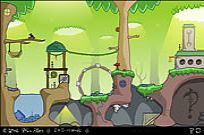
I first played Hapland during the Flash era, when small browser games were a common way to pass time. It was a simple point-and-click puzzle set in a single, static screen. You would click on things in the environment, hoping something would happen.
You control nothing but a cursor. Your only action is to click on parts of the illustrated scene, like a tree, a rock, or a door. The goal is to free a character trapped in a cage, which involves setting off a long chain of cause and effect. You might click a lever to lower a bridge, which allows a rolling boulder to pass, which then hits a switch. The puzzles are opaque and the solutions are often illogical, requiring many failed attempts. Progress feels slow and deliberate, punctuated by moments of sudden, accidental discovery. The game feels like poking at a mysterious machine, never quite sure which part will move next.